Connect with us

Politics

“The Dragon Exchange” How the Philippine Supreme Court Was Folded Into the Plot to Erase Duterte – Teddy Adarna

mm

Published

on

The Silent Tribunal – How the CIA and Supreme Court Helped Topple Duterte | Part II of The Dragon Exchange

Part II of “The Dragon Exchange” – The CIA Blueprint for Regime Decapitation: How the Supreme Court Was Folded Into the Plot to Erase Duterte.

In Washington, they call it “regime recalibration.” In Langley, they call it business as usual. When a foreign leader grows too unpredictable, too loyal to national sovereignty, too fond of China or Russia, or simply too uncontrollable, the Central Intelligence Agency does not fire a bullet. They do not need to. They simply tilt the judiciary, bribe the legislature, and let the host country destroy itself.  Welcome to the Philippines, 2025.


ACT I: The Dragon Had to Die
Rodrigo Roa Duterte was no saint. But to the transnational order the one brokered in corridors of the Pentagon and Davos he was something far worse:

Advertisement

An ungovernable populist with his own power base, unaligned with U.S. strategic doctrine. He befriended China. Threatened to eject American forces. Spoke openly of independence. Worse, he was too effective. The Filipino masses adored him. And that, in the eyes of Langley, was unforgivable. So when he stepped down in 2022, the kill clock began ticking. Slowly. Surgically.

The Marcos-Romualdez clan, long familiar to the CIA playbook, was repositioned as the “soft power wing.” Access was granted. Dialogue reopened. Conditions were set.
And behind the scenes, Operation Silencer moved into phase two.


ACT II: Co-opt the Court. Corner the Dragon.

First, the judiciary must be made docile. The Philippine Supreme Court, though symbolic, remained the final obstacle to a full regime transition. It had to be boxed, bribed, or broken.

Advertisement

So the old playbook was dusted off one used in Iran, Chile, Ukraine, and Indonesia:

• Discredit the old guard (PRRD and his legal allies).• Compromise judges with “development incentives” clean, digital, untraceable.
• Delay all arguments surrounding the controversial “pork-laden” national budget, now rumored to be packed with shadow allocations meant to fund loyalist operations in Congress and media.

Speaker Martin Romualdez, allegedly now a “trusted node” for U.S. Pacific policy coordination, was given quiet backing. He mobilized operatives to surgically weaken Duterte’s last judicial shields—and rerouted congressional momentum into something far more sinister: a purge.


ACT III: The Langley Fingerprint

Advertisement

Insiders in Camp Aguinaldo and the DFA claim they’ve seen it before:
• Sudden legal harassment of anti-U.S. figures.
• The arrest of PRRD under dubious charges a political execution masked as a procedural act.
• The impeachment of Sara Duterte, his daughter

It’s all too familiar. Like Allende in 1973. Like Noriega in 1989. Like Gaddafi before the drone. And then there’s the digital warfare smear campaigns against nationalist politicians, TikTok psyops, and “think tank” reports flooding local media, funded quietly through cutouts and NGOs headquartered in New York or Virginia. The dragon was not just caged.

He was digitally erased and legally euthanized.


ACT IV: The Court That Pretended Not to Hear

Advertisement

Where is the Supreme Court in all this?
Silent. Motionless. Possibly compromised.

• They’ve delayed hearings on the budget scandal everyone is whispering about.
• They’ve shown no urgency in reviewing the legality of Duterte’s arrest.
• Their institutional resistance is suspiciously absent—as if the gavel is being held at gunpoint.

Unlike the executive the supreme court do not have an army to protect itself.
We are witnessing the quiet death of judicial independence.

Not by martial law.
Not by executive order.
But by foreign manipulation and internal compliance.

Advertisement


FINAL ACT: The American Design for the Pacific

Make no mistake. This is not just about Duterte. It’s about the Philippines’ role in the U.S.-China cold war.
The U.S. cannot afford a rogue democracy at the edge of the South China Sea. And so, the architecture must be changed:

• Install a loyal, Western-aligned political elite.
• Erase all anti-U.S. symbols (Duterte, his daughter, nationalist generals).
• Subdue the courts, rig the budget, reframe the narrative.

And do it under the guise of law, democracy, and “anti-corruption.”
It’s a regime change without tanks. A conquest with gavels instead of guns.

Advertisement


CODA: The Real Battlefield

While the public is distracted by the sabungeros’ disappearance, celebrity scandals, and price hikes, a new republic is being born silently engineered not by Filipinos, but by foreign strategists fluent in destabilization.Ask yourself:
If the Supreme Court no longer speaks, and our leaders obey foreign interests…

Who governs the Republic?
Not Malacañang.
Not Batasan.
Certainly not the People.

The answer is far more terrifying than fiction.

Advertisement

⚖️ Final Remarks: A Theory, A Warning, A Whisper in the Fog
This editorial, like all dangerous truths, stands not as indictment, but as theory.
Not as proof but as a shadow cast by the fire behind the curtain. The names, the movements, the mechanisms—all stitched together from open secrets, digital crumbs, and the uneasy silence of institutions once known for roar.

I do not claim certainty.
I claim suspicion, and in a nation where silence often precedes subjugation, suspicion is the last candle lit before the darkness arrives.

History does not always announce itself with sirens or breaking news.
Sometimes it enters quietly, in robes and rulings. In backroom handshakes. In the glint of a well-placed bribe. In a ruling never written. In a hearing never scheduled. And if we are not vigilant if we mistake silence for peace, we will wake up in a Republic that no longer belongs to us. So let this piece stand as what it truly is:

A theory sharpened by paranoia.
A speculation carved from patterns.
A whisper in the fog—meant not to scare, but to stir.
Because when the Supreme Court forgets how to speak,
It is our duty to shout in its place. And if we are wrong?

Advertisement

Then may history absolve us.
But if we are right?

Then may this document be the proof that someone saw it coming and dared to scream.

From: Teddy Adarna  

Advertisement

Comments

comments

Advertisement

Politics

When Disclosure Crosses the Line: The Hidden Legal Dangers in Sara’s Bank Data Revelation

mm

Published

on

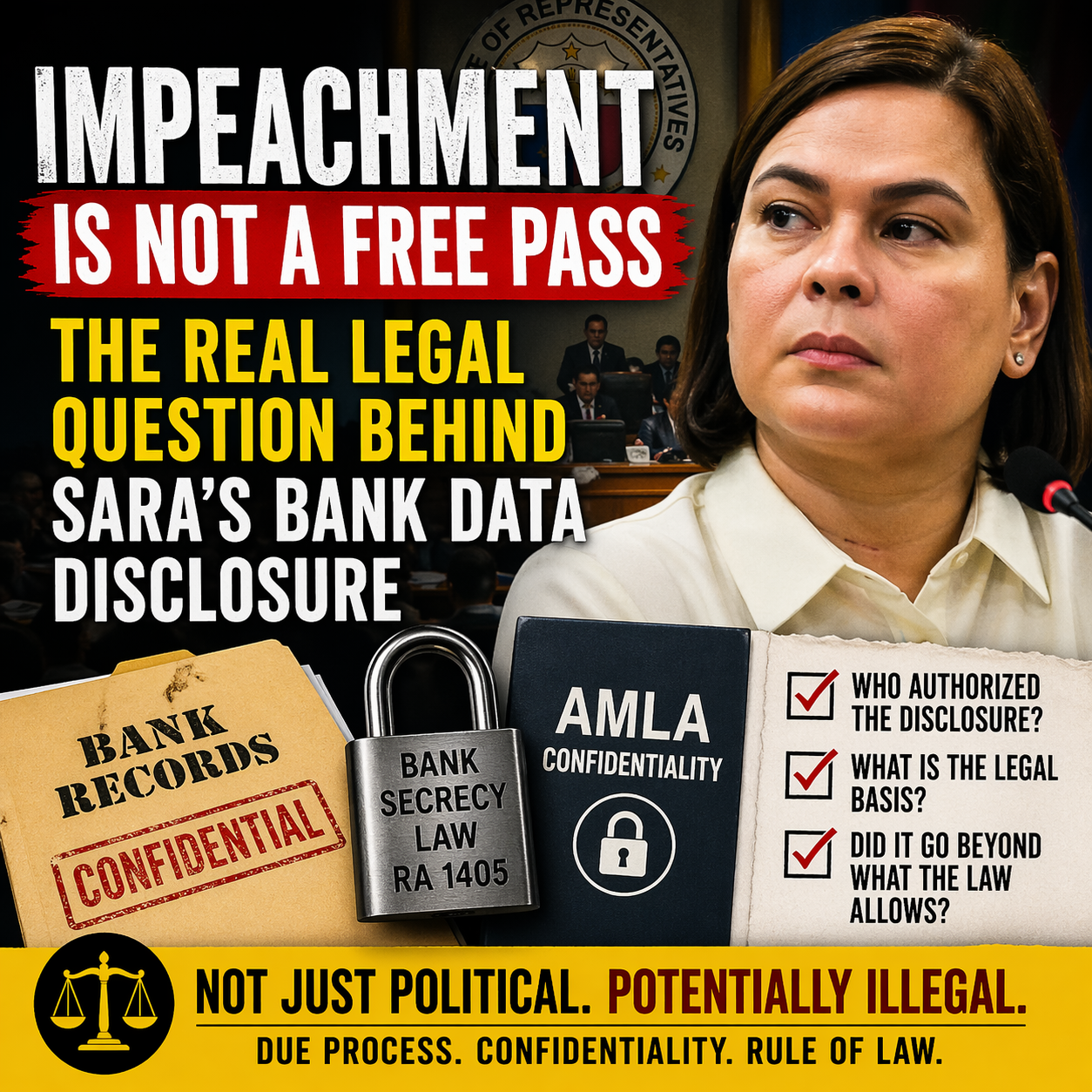
Impeachment Is Not a Free Pass: Legal Issues Behind Sara’s Bank Data Disclosure

I asked a friend of mine who is also a lawyer about this. – And ang sabi niya, if Sara’s bank details were publicly divulged in the April 22 House Committee on Justice hearing, the deeper issue is this: who authorized the public disclosure, under what legal basis, and did that disclosure go beyond what the law actually allows?

Yes, may argument sila that bank secrecy may be pierced in impeachment proceedings, because RA 1405 itself recognizes an exception for “cases of impeachment.” Pero sabi ng friend ko, hindi doon nagtatapos ang usapan.

That is only one layer of the legal framework.

May hiwalay pang issue: AMLA confidentiality.

Suspicious Transaction Report (STR) and Covered Transaction Report (CTR) are not ordinary chismis material that can just be read out in public as if they were campaign props. Having an STR or CTR does not by itself prove wrongdoing. It only means the transaction was reported under AMLA rules for review, monitoring, or possible investigation. And the AMLA imposes confidentiality rules, and Philippine jurisprudence has recognized that these reports are protected from disclosure outside the law’s authorized channels. So kahit sabihin pa nila na puwedeng sumilip ang impeachment body, that does not automatically mean puwede nang i-broadcast or i-divulge publicly ang AMLC-reported data.

So ang dapat tinatanong daw is: Did the subpoena justify public recital of the information, or only lawful production within a proper legal process? Magkaiba daw yon. At doon puwedeng sumabit ang mga taong nag-request, nag-authorize, at nagbasa ng details in open hearing.

Kaya kung mapatunayang lumampas sa pinapayagan ng batas ang nangyari, hindi puwedeng walang managot. The possible legal exposure would not just be political. It could extend to the officials who actually disclosed the information, and to those who compelled or facilitated that disclosure in a way later found unlawful. But to be precise, sabi niya, as of now, this is still a contested legal issue, not yet a final judicial finding of violation.

MY TAKE

Impeachment is not a magic wand.

Hindi porke may hearing, puwede nang baliwalain ang confidentiality safeguards. Hindi porke politically useful, automatic nang legal.

At kung ginawa nilang public spectacle ang data na protektado ng batas, then the real issue is no longer just the allegations pointed at VP Sara. The real issue becomes abuse of process, weaponization of disclosure, and whether rule of law was bent for politics.

•••

OPINION | ROB RANCES

The views expressed here are opinion and analysis on issues of public concern, grounded in publicly available information. Allegations, if mentioned, remain subject to verification, due process, and proper determination by the appropriate authorities.


Sara Duterte, impeachment Philippines, bank secrecy law, RA 1405, AMLA confidentiality, AMLC, STR CTR meaning, House Committee on Justice, Philippine law, legal analysis Philippines, bank data disclosure, due process, rule of law, political controversy Philippines, financial privacy law

Advertisement

#SaraDuterte #ImpeachmentPH #AMLA #BankSecrecy #RuleOfLaw #PhilippinePolitics #LegalAnalysis #DueProcess #AMLC #PublicAccountability

Comments

comments

Continue Reading

Politics

The Fixation of Ridon Seen Again – Atty. Raymond B Batu (Opinion)

mm

Published

on

SALN vs AMLC Explained: Why Financial Flow Is Not Net Worth
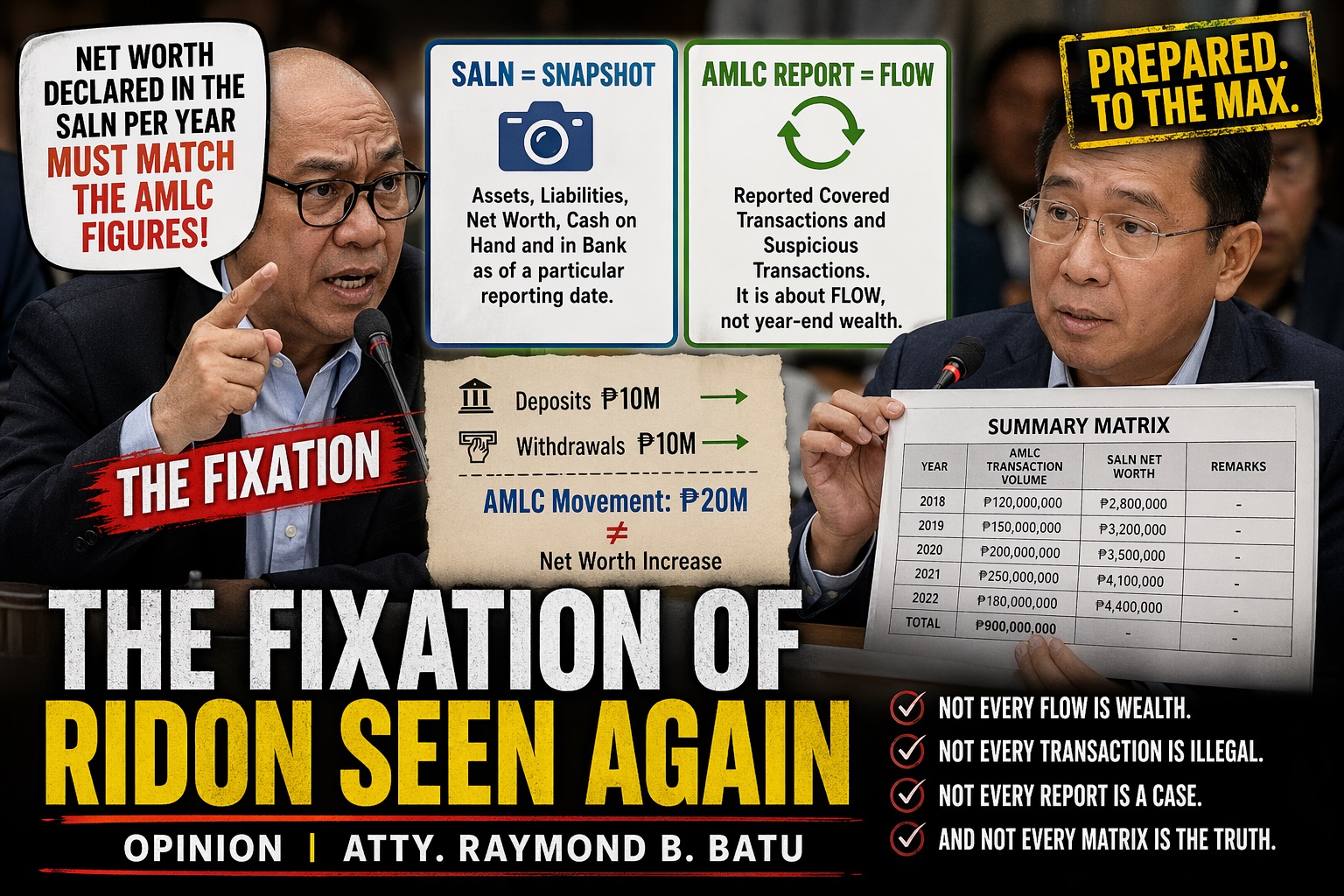
Again, we see the same 𝗳𝗶𝘅𝗮𝘁𝗶𝗼𝗻. While AMLC was discussing 𝗳𝗶𝗻𝗮𝗻𝗰𝗶𝗮𝗹 𝗮𝗰𝘁𝗶𝘃𝗶𝘁𝘆 per year, Ridon kept interjecting the 𝗻𝗲𝘁 𝘄𝗼𝗿𝘁𝗵 declared in the SALN per year, as if the two were supposed to match automatically. Then the Chair already had a 𝘀𝘂𝗺𝗺𝗮𝗿𝘆 or 𝗺𝗮𝘁𝗿𝗶𝘅 ready. Prepared to the max talaga.
𝗞𝗹𝗮𝗿𝘂𝗵𝗶𝗻 𝗻𝗮𝘁𝗶𝗻.
The 𝗻𝗲𝘁 𝘄𝗼𝗿𝘁𝗵 in a SALN and the 𝗳𝗶𝗻𝗮𝗻𝗰𝗶𝗮𝗹 𝗮𝗰𝘁𝗶𝘃𝗶𝘁𝘆 reflected in AMLC reports are 𝗳𝘂𝗻𝗱𝗮𝗺𝗲𝗻𝘁𝗮𝗹𝗹𝘆 𝗱𝗶𝗳𝗳𝗲𝗿𝗲𝗻𝘁 𝗳𝗶𝗻𝗮𝗻𝗰𝗶𝗮𝗹 𝗺𝗲𝘁𝗿𝗶𝗰𝘀.
A SALN is a 𝗦𝗡𝗔𝗣𝗦𝗛𝗢𝗧. It shows the declarant’s 𝗮𝘀𝘀𝗲𝘁𝘀, 𝗹𝗶𝗮𝗯𝗶𝗹𝗶𝘁𝗶𝗲𝘀, 𝗻𝗲𝘁 𝘄𝗼𝗿𝘁𝗵, and declared 𝗰𝗮𝘀𝗵 𝗼𝗻 𝗵𝗮𝗻𝗱 𝗮𝗻𝗱 𝗶𝗻 𝗯𝗮𝗻𝗸 as of a particular reporting date.
An AMLC report, on the other hand, refers to 𝗳𝗶𝗻𝗮𝗻𝗰𝗶𝗮𝗹 𝗺𝗼𝘃𝗲𝗺𝗲𝗻𝘁. It deals with reported 𝗰𝗼𝘃𝗲𝗿𝗲𝗱 𝘁𝗿𝗮𝗻𝘀𝗮𝗰𝘁𝗶𝗼𝗻𝘀 and 𝘀𝘂𝘀𝗽𝗶𝗰𝗶𝗼𝘂𝘀 𝘁𝗿𝗮𝗻𝘀𝗮𝗰𝘁𝗶𝗼𝗻𝘀. That is about 𝗳𝗹𝗼𝘄. It is not the same as year-end 𝘄𝗲𝗮𝗹𝘁𝗵.
So no, a high AMLC transaction volume does 𝗻𝗼𝘁 automatically mean the same amount must appear as 𝗻𝗲𝘁 𝘄𝗼𝗿𝘁𝗵 in the SALN.
If a person deposits ₱10 million and withdraws ₱10 million within the same period, the AMLC-reported 𝗺𝗼𝘃𝗲𝗺𝗲𝗻𝘁 may reflect ₱20 million in activity. But that does not mean the person’s 𝗻𝗲𝘁 𝘄𝗼𝗿𝘁𝗵 increases by ₱20 million. That is basic.
That is why comparing 𝗦𝗔𝗟𝗡 𝗻𝗲𝘁 𝘄𝗼𝗿𝘁𝗵 and 𝗔𝗠𝗟𝗖 𝘁𝗿𝗮𝗻𝘀𝗮𝗰𝘁𝗶𝗼𝗻 𝗳𝗹𝗼𝘄 as if they are identical figures is either a 𝗴𝗿𝗮𝘃𝗲 𝗺𝗶𝘀𝘂𝗻𝗱𝗲𝗿𝘀𝘁𝗮𝗻𝗱𝗶𝗻𝗴 or a 𝗱𝗲𝗹𝗶𝗯𝗲𝗿𝗮𝘁𝗲 𝗮𝘁𝘁𝗲𝗺𝗽𝘁 to mislead the public.
Yes, large transaction volume may justify 𝗳𝘂𝗿𝘁𝗵𝗲𝗿 𝗶𝗻𝗾𝘂𝗶𝗿𝘆. But it is 𝗻𝗼𝘁 automatic proof of wrongdoing. It is 𝗻𝗼𝘁 automatic proof of undeclared wealth. It is 𝗻𝗼𝘁 automatic proof of money laundering.
The real questions remain:
𝗪𝗮𝘀 𝗼𝗿 𝗶𝘀 𝘁𝗵𝗲𝗿𝗲 𝗮𝗻𝘆 𝗰𝗼𝗺𝗽𝗲𝘁𝗲𝗻𝘁 𝗶𝗻𝘃𝗲𝘀𝘁𝗶𝗴𝗮𝘁𝗶𝗼𝗻?
𝗪𝗮𝘀 𝘁𝗵𝗲𝗿𝗲 𝗮𝗻𝘆 𝗳𝗼𝗿𝗺𝗮𝗹 𝗰𝗮𝘀𝗲 𝗳𝗶𝗹𝗲𝗱?
𝗢𝗿 𝗮𝗿𝗲 𝘁𝗵𝗲𝘆 𝗷𝘂𝘀𝘁 𝘄𝗮𝘃𝗶𝗻𝗴 around gross figures to create 𝗽𝗼𝗹𝗶𝘁𝗶𝗰𝗮𝗹 𝗶𝗺𝗽𝗿𝗲𝘀𝘀𝗶𝗼𝗻?
That is the point.
Not every 𝗳𝗹𝗼𝘄 is 𝘄𝗲𝗮𝗹𝘁𝗵.
Not every 𝘁𝗿𝗮𝗻𝘀𝗮𝗰𝘁𝗶𝗼𝗻 is 𝗶𝗹𝗹𝗲𝗴𝗮𝗹.
Not every 𝗿𝗲𝗽𝗼𝗿𝘁 is a 𝗰𝗮𝘀𝗲.
And not every 𝗺𝗮𝘁𝗿𝗶𝘅 is the 𝘁𝗿𝘂𝘁𝗵.
𝗧𝗛𝗘 𝗙𝗜𝗫𝗔𝗧𝗜𝗢𝗡 𝗢𝗙 𝗥𝗜𝗗𝗢𝗡 𝗦𝗘𝗘𝗡 𝗔𝗚𝗔𝗜𝗡
𝗢𝗽𝗶𝗻𝗶𝗼𝗻 | 𝗔𝘁𝘁𝘆. 𝗥𝗮𝘆𝗺𝗼𝗻𝗱 𝗕. 𝗕𝗮𝘁𝘂

Comments

comments

Continue Reading

Government

Marcos Jr. Desperate Move Using Politics to Silence Duterte and Secure His Power and Dynasty – Opinyon

mm

Published

on

The Battle Beyond Justice

The recent political landscape in the Philippines exposes a harsh reality—this is not about justice but pure political maneuvering. President Bongbong Marcos’ senatorial slate suffered humiliating defeats, signaling a weakening grip on power. Meanwhile, former President Rodrigo Duterte remains a dominant figure, loved by millions, and seen as the strongest political rival Marcos faces today.

With the looming ICC case against Duterte, it’s impossible to ignore the deeper political agenda at play. The attempt to prosecute him isn’t just about seeking justice—it’s about eliminating him from the equation. Marcos and his allies know that as long as Duterte holds influence, he threatens their political dynasty. By removing him from the scene, they pave the way for their own continuity, ensuring that the next Marcos heir takes over.

A Popular Leader vs. A Fading Dynasty

Despite relentless attacks, Duterte’s popularity remains unshaken. His strongman leadership, no-nonsense policies, and connection with the masses continue to define his presence in Philippine politics. Wherever he goes, massive crowds welcome him—a clear indication that the people have not abandoned him.

Advertisement

This is what threatens Marcos the most. Unlike Duterte, whose influence is built on genuine public support, Marcos struggles to solidify his base. The recent electoral losses of his allies reflect this vulnerability. And so, instead of competing fairly, the strategy shifts to using international bodies and legal cases to discredit and possibly remove Duterte altogether.

Weaponizing the ICC for Political Gain

It is undeniable that the ICC investigation resurfaced at a convenient time—just as political tension between the Marcos and Duterte camps intensified. The case is being used as a tool to neutralize Duterte, ensuring that he cannot interfere with the future plans of the Marcos political dynasty. If successful, it could sideline Duterte’s influence before the next elections, leaving Marcos with a clearer path to securing power for his successors.

This isn’t about justice. If it were, why isn’t Marcos held accountable for the injustices of his own family’s past? Why does the ICC’s interest conveniently align with the political ambitions of the current administration? These questions expose the hypocrisy behind the case against Duterte.

Palace Press Officer Undersecretary Claire Castro confirmed that the Office of the President paid for the private jet that transported former President Rodrigo Duterte to The Hague, Netherlands.

Advertisement

According to Atty. Claire Castro, this was part of the Philippine government’s full cooperation in executing the arrest. However, many question why Marcos went beyond merely following ICC orders, considering that the ICC has no jurisdiction over the Philippines. Without the Philippine government’s cooperation, it would have been difficult for the ICC to arrest Duterte—just as it has been unable to act on its cases against Russian President Vladimir Putin and Israeli leaders.

Atty. Reserva pointed out the inconsistency, stating, “We fight for our fellow Filipinos abroad to protect them when they face criminal charges. Yet in the case of FPRRD, he has not even been convicted in our country, and we are surrendering him just like that?”

#marcos, #bongbongmarcos, #duterte, #duterteicc, #rodrigoduterte

Advertisement

Comments

comments

Continue Reading
Advertisement